
Salary structures
Define the components — basic, allowances, deductions — once per grade and reuse them.
Define salary structures once, then process a month for every member of staff: payslips generated, deductions applied, and the totals you need for the transfer and the returns.
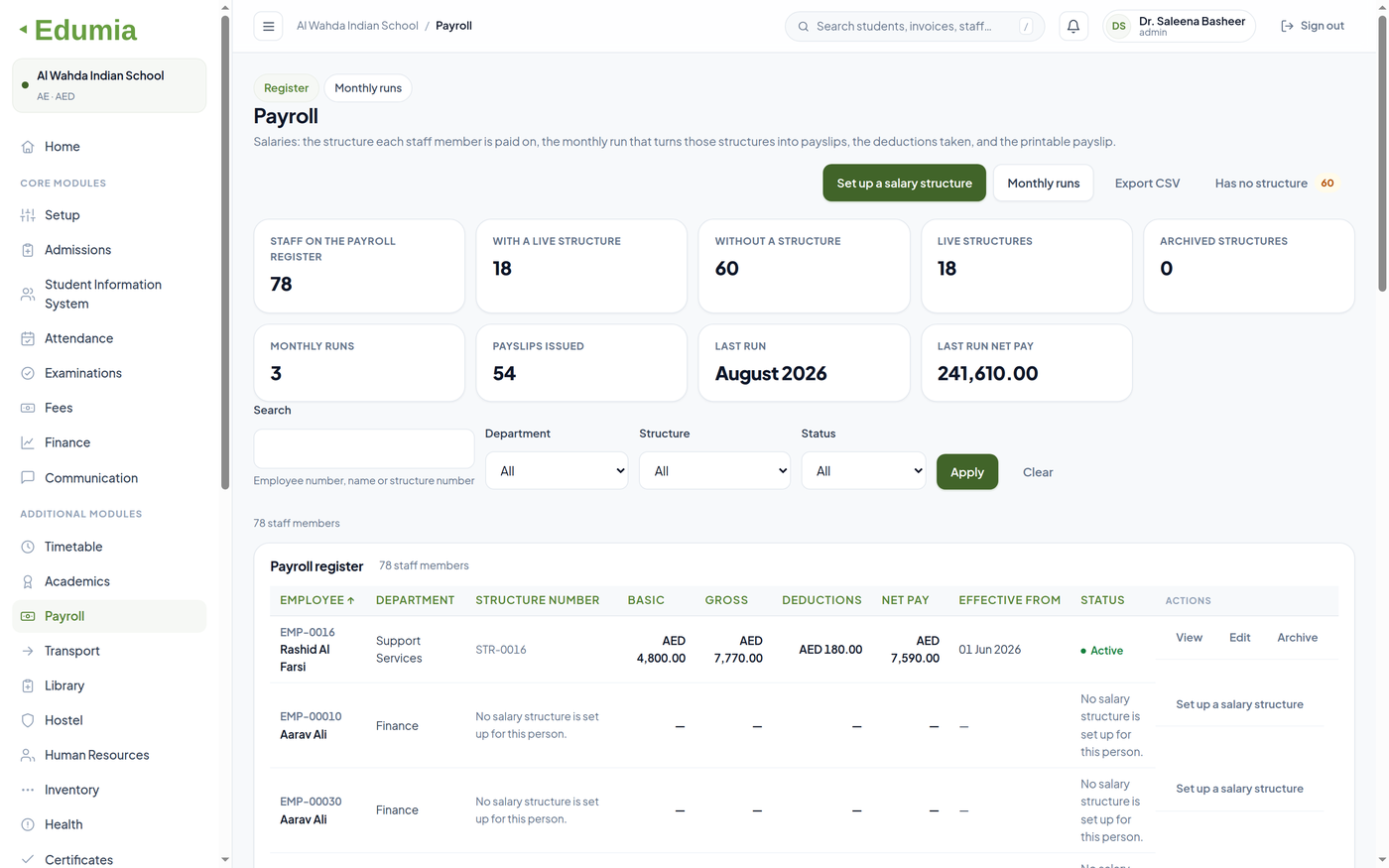
Define the components — basic, allowances, deductions — once per grade and reuse them.
Process a month for every member of staff, or for a subset when someone joins mid-month.
Generate a payslip per employee, ready to print or hand out.
Print every payslip in a run together, rather than one at a time.
The totals you need for the transfer and the returns, without a separate exercise.
A completed run is kept as it was processed, so a past month stays reproducible.
Yes. Components — basic, allowances and deductions — are defined once per grade and reused each month.
A run can cover every member of staff, or a subset when someone joins partway through a month.
A payslip is generated per employee and a full run can be printed together rather than one at a time.
The reason staff records go stale is that schools try to keep all of them. Keep the handful that payroll, leave and compliance actually read, and let the rest be optional.
Read: Managing teaching staff records when nobody has timeA payslip is only as good as the salary structure behind it. Here is what a teacher's payslip has to show, line by line, and how to stop rebuilding the structure by hand every month.
Read: Teacher salary structure: what has to be on the payslipFinance & fees — fee structures, collection, dues, expenses, payroll and reconciliation.
Explore moduleFinance — heads, ledger entries, vouchers and the income-and-expenditure position.
Explore moduleReports — enrolment, collection, attendance and performance reporting for management.
Explore moduleStart a 30-day trial and our team will set up the module against your real academic structure.